

Brand-new cancer drugs typically take about 10 to 20 years to develop. And that’s just too long, as far as Fred Hutchinson Cancer Center’s Taran Gujral, PhD, is concerned — especially when it comes to rare cancers that are less likely to get attention from the pharmaceutical industry.
Instead of pouring resources and research into developing brand-new compounds, running them through a barrage of preclinical and eventually human clinical trials, the systems biologist has come up with a faster, high-tech workaround.
Dr Gujral and his lab created a drug-matching platform that uses artificial intelligence (AI) to help researchers, clinicians and, most importantly, patients, find additional uses for drugs that have already gone through clinical trials and received approval from the FDA.
This AI-powered drug-matching platform, Dr Gujral believes, will prove especially beneficial for addressing the rare cancers that collectively affect more than 400,000 Americans every year but are often shunted to the bottom of the research barrel.
New Uses for Approved Drugs
According to the American Cancer Society, 1 in 5 cancers is “rare,” defined as a cancer with fewer than 6 cases per 100,000 people per year.
But rare cancers add up.
“Individually, rare cancers are not common, but collectively, they are,” Dr Gujral said. “There are 200 or more diseases that can be classified as rare cancers. The biggest barrier in these cancers is the lack of interest from stakeholders. It’s not possible to benefit people with rare cancers using traditional clinical trial design, because you can’t run a traditional trial with only dozens or a few hundred cases [of a cancer]. You have to amend your methods. This is a challenge that the FDA recognizes.”
The FDA not only recognizes the challenge; the FDA awarded Dr Gujral a 5-year, $2.5-million Novel Approaches in Ultra-Rare Cancers grant to use his drug-matching platform to indicate safe, preapproved therapies that can be repurposed for people with rare cancers. His was the only grant funded through this mechanism.
He used those funds to launch TRACER, Fred Hutch’s Transformative Rare Cancer Initiative.
“The grant is specifically for approaches to find effective drugs for ultra-rare cancers,” Dr Gujral said, explaining the challenges of research in this realm, including finding the targets, developing the drugs, and then running the clinical trials over a number of years. “This is the first time they’ve put out an RFA [request for applications] for this. The FDA is proactively encouraging investigators to innovate new approaches.”
Dr Gujral’s approach is simple, fast — and safe.
“We’re using drugs that are FDA-approved,” he said. “We’re not testing unproven or unsafe drugs. We’re looking at a collection of FDA-approved drugs, but not just oncology drugs. So that’s groundbreaking.”
The drug-matching platform is not meant to replace the current standard of care for a patient diagnosed with cancer, he stressed.
“If someone is diagnosed with [a type of] lung cancer, they’ll go through molecular subtyping and there are drugs and therapies that they’ll go on,” he said. “This is not going to replace those options. This platform is for when nothing works, or when current treatment stops working.”
Even common cancers like breast or lung or prostate will tap out of treatments once they become metastatic and spread to other organs like the liver or lungs. Dr Gujral believes his drug-matching system will also be useful in finding treatments for patients with these cancers.
“It’s a similar idea,” he said.
For now, though, he wants to use his system to help identify potential treatments where no current treatment or therapy exists and no one is looking for one because there’s no money in it.
“This is where we could make a difference — where it could be useful for clinics and oncologists and patients, when it’s the kind of tumor that doesn’t occur very often and there is no available standard-of-care treatment," Gujral said.
Connecting With the Rare Cancer Community
Dr Gujral has a dual vision for his new TRACER initiative.
First, he wants to fast-forward rare cancer research, period — by offering the ability to collaborate with other rare cancer researchers across the United States and beyond.
But he also has longer-term goals: He wants to develop much-needed research resources like cell lines and/or patient-derived xenografts, or PDXs (mouse models with human tumors). This will help facilitate a much deeper understanding of various rare cancers and benefit the research community and patients for years to come.
“There are rare cancer programs at every major cancer center,” Dr Gujral said. “And they’re all starting to collaborate among themselves.”
The Dana-Farber/Boston Children’s Cancer and Blood Disorders Center has the Rare Tumors Program; Memorial Sloan Kettering raises money for rare cancer research every year through its Cycle for Survival, and the University of Texas MD Anderson Cancer Center recently teamed up with the Rare Cancer Research Foundation. In addition, the Target Cancer Foundation has supported rare cancer research since 2009. Furthermore, the National Cancer Institute, or NCI, launched MyPART, a pediatric and adult rare tumor network, that focuses on childhood, teen and young adult rare solid tumors that currently have no cures.
“My hope is TRACER can plug into this framework,” Dr Gujral said. “We need a structure for many institutions to work together. If we can come together and not work in silos, we can make much bigger strides.”
That’s one reason Dr Gujral has dedicated himself into connecting with rare cancer groups, clinicians and patient advocates to see where the gaps are in the existing programs and how TRACER, housed within Fred Hutch’s Seattle Translational Tumor Research (STTR,) can help fill them.
His goal is to build a program that will complement rare cancer research efforts at other institutions, by using a platform that goes beyond genetic analysis of patients’ tumors. Dr Gujral’s approach incorporates molecular and functional information gleaned from patients’ tumor tissue and grown in a lab in a way that maintains their 3-dimensional structure and cellular functions.
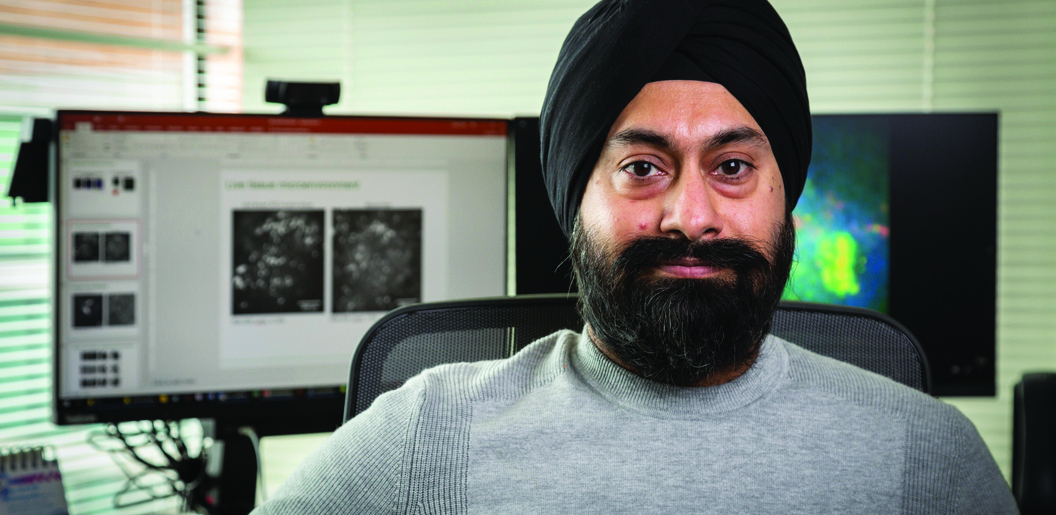
Fred Hutch's Dr. Taran Gujral launched TRACER, the Transformative Rare Cancer Initiative, with a $2.5 million grant from the U.S. Food & Drug Administration.
This approach could help overcome hurdles that have hampered the translation of potential treatments, said John Hopper, cofounder and cochair of the Rare Cancer Coalition at the National Organization for Rare Disorders, and a founding member of TRACER’s advisory board.
A self-described “caregiver with a business background,” Hopper works to build connections between patient advocates, researchers, and funding — a crucial endeavor when only a few patients in the United States may share the same diagnosis. The rare liver cancer fibrolamellar, for instance, occurs in only 1 out of 5 million people, usually affecting children or young adults.
“It’s usually found in stage IV,” Hopper said. “Unfortunately the 5-year survival rate is alarmingly low. We've lost too many young lives as there is still no standard of care or curative therapies for fibrolamellar — as is the case with most rare cancers. We need to change that paradigm.”
Rare cancers are a “challenging space,” he said — and not just because they affect smaller clusters of patients.
“There’s not a lot of incentive for drug companies to pursue drugs,” Hopper said. “Many early-stage biotech companies come up with molecules that have hope, but then they run out of money and the initiative just gets dropped.”
Dr Gujral’s approach is more advanced, he said.
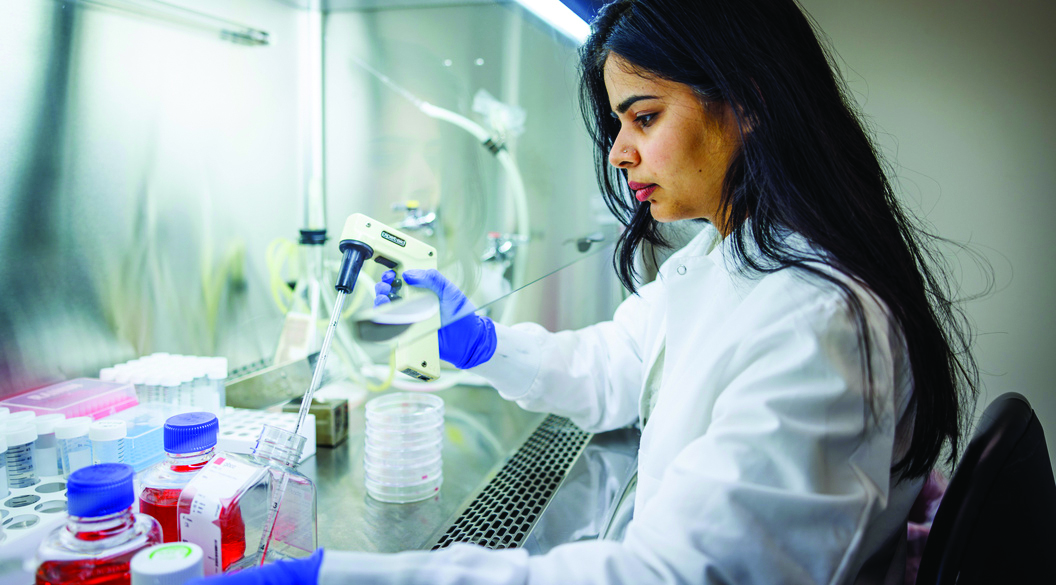
Dr. Palak Ahuja works in the Tissue Culture room within Fred Hutch's Gujral Lab.
“It can be very precise as to what drugs and drug combinations can be effective on the specific cancer,” he said. “Many are doing analysis at the DNA level — [Dr Gujral] goes down to the tissue and functional level where you have a higher probability that the drug or drug combination will be successful in a patient.”
”There’s a need for new drugs, but there’s more of a need to find new uses for existing drugs.”
“[Dr Gujral is] accelerating the whole approach,” said Hopper. “Historically, the rare cancer community gets stifled by too many conversations, rehashing the same issues with little to no action resulting. Who’s going to take steps and truly make a difference sooner rather than later? Others are slowly working on it, but [Dr Gujral’s] got this attitude that ‘I’m just going to go ahead and do it. I’m going to make it happen.’”
That approach is just the ticket, Hopper believes. “While many in research simply talk about ‘collaboration,’ [Dr Gujral] actually does it," he said. “There doesn’t seem to be an ego there. He truly embraces and encourages a collaborative approach to solving problems. That’s why organizations like the NCI and the FDA are excited about opportunities to work with him. He’s going to create a movement, and many individuals and organizations will want to be a part of it. And that will hopefully result in much-needed breakthroughs for the rare cancer community.”
Dr Gujral is already connecting with faculty from the University of Washington, Fred Hutch, and Seattle Children’s to glean tissue samples from patients with rare cancers who’ve exhausted all available treatments.
“Right now, we have rare tumor samples for rhabdomyosarcoma, a soft tissue sarcoma that often affects children, ready for profiling,” he said. “We also received two LAMN cases — super rare appendix tumors hitting only about 1000 to 2000 people in the [United States] every year. Our main goal right now is to get support for our faculty members so they can really dive into the science and make some headway with these rare cancers.”
Dr Gujral is engaging with researchers nationwide — including from the FDA and NCI — to create a multidisciplinary rare cancer “tumor team” and just put out his first RFA for in-kind services between TRACER and other rare cancer research labs.
“We want to swap services in order to accelerate rare cancer research,” Dr Gujral said. “If you’re a rare cancer lab and have samples in your freezer, we can help pay for molecular sequencing if you have a case you’re working on. Or if you have a tumor specimen, we can help you build a mouse model. Or if you have frozen tumor samples, we can help with a drug screening.”
In addition to building TRACER’s advisory board, Dr Gujral is also planning a rare cancer symposium, to be held on the Fred Hutch campus on March 27, 2025.
First Applied to COVID-19
The longtime systems biologist first came up with the idea of a drug-matching platform during the early days of the COVID-19 pandemic. He focused first on a class of compounds known as kinase inhibitors and worked with a team of Fred Hutch infectious disease experts to identify and validate a handful of FDA-approved compounds capable of inhibiting inflammatory immune reactions certain COVID-19 patients faced.
But these represented only 1 class of drugs. He soon realized he could move beyond COVID — and the kinase pathway.
He partnered with Fred Hutch’s Pete Nelson, MD, who holds the Stuart and Molly Sloan Precision Oncology Institute Endowed Chair, to see if his machine learning–based drug screening platform could identify potential drugs that could be repurposed to help patients who have exhausted all their metastatic prostate cancer treatments. Again, he produced matches.
“We’re looking at all kinds of drugs now,” Dr Gujral said. “We’ve gone beyond kinase inhibitors — now it can be any drug.”
In addition to creating TRACER, the grant from the FDA will allow Dr Gujral and his team to directly test drugs on tissues from various patients’ rare cancers.
But he’s not content with just finding drugs that can target rare cancers. Like most scientists, he wants to know why — exactly — these matched drugs work on the tumors.
“When we get these hits, we try to figure out why it works,” Dr Gujral said. “These drugs are often built for 1 or 2 targets, but we know they target many other things. We’re going to test these drugs in mouse models with the same tumor as the patient so we know what it’s doing to make the tumor shrink. Having all that data and insight is valuable to understand the biology.”
He’s also developing valuable rare cancer tumor models.
So far, the team has produced and disseminated preclinical models of fibrolamellar cancer, ependymoma, and epithelioid hemangioendothelioma, a rare cancer in the cells that make up blood vessels. In days to come, the team plans to develop additional preclinical models including cell lines, organoids, and PDXs.
Eric Holland, MD, PhD, who is senior vice president and director of Fred Hutch’s Human Biology Division and holds the Endowed Chair in Cancer Biology and heads STTR, said he is enthusiastic about TRACER’s launch — and its mission.
“The Transformative Rare Cancer Research Initiative is an exciting opportunity for cross-collaboration within the current STTR tumor teams,” he said. “The team will build on existing partnerships, spark new collaborations and help build momentum for the rare cancer community.”
Additional Funding Needed
Solving the science and building and maintaining momentum is just part of it, however.
Dr Gujral said there are many other challenges ahead for the TRACER team. Funding, he said, will be a major hurdle. Questions — specifically about whether a patient’s insurance will cover the cost of the analysis or any repurposed drugs found via the platform — will also need to be resolved.
But he remains optimistic about what he sees as a winning proposition.
“It’s in the interest of all the stakeholders, including the pharmaceutical and insurance companies, to expand the use of their drugs to expand their market size,” he said. “Once a drug is approved for 1 cancer, it’s in their interest to see if it will work in other indications and expand the profiles.”
“Pharma wins, insurance wins — and mainly, the patients win,” he said.
Editor’s Note: This article was reproduced, with permission from the Fred Hutchinson Cancer Center Communications Team.About the authors
Diane Mapes is a staff writer at Fred Hutchinson Cancer Center. She has written extensively about health issues for NBC News, TODAY, CNN, MSN, Seattle Magazine, and other publications. A breast cancer survivor, she blogs at doublewhammied.com and tweets @double_whammied. Email her at
Sabrina Richards, a staff writer at Fred Hutchinson Cancer Center, has written about scientific research and the environment for The Scientist and OnEarth Magazine. She has a PhD in immunology from the University of Washington, an MA in journalism and an advanced certificate from the Science, Health and Environmental Reporting Program at New York University. Reach her at