

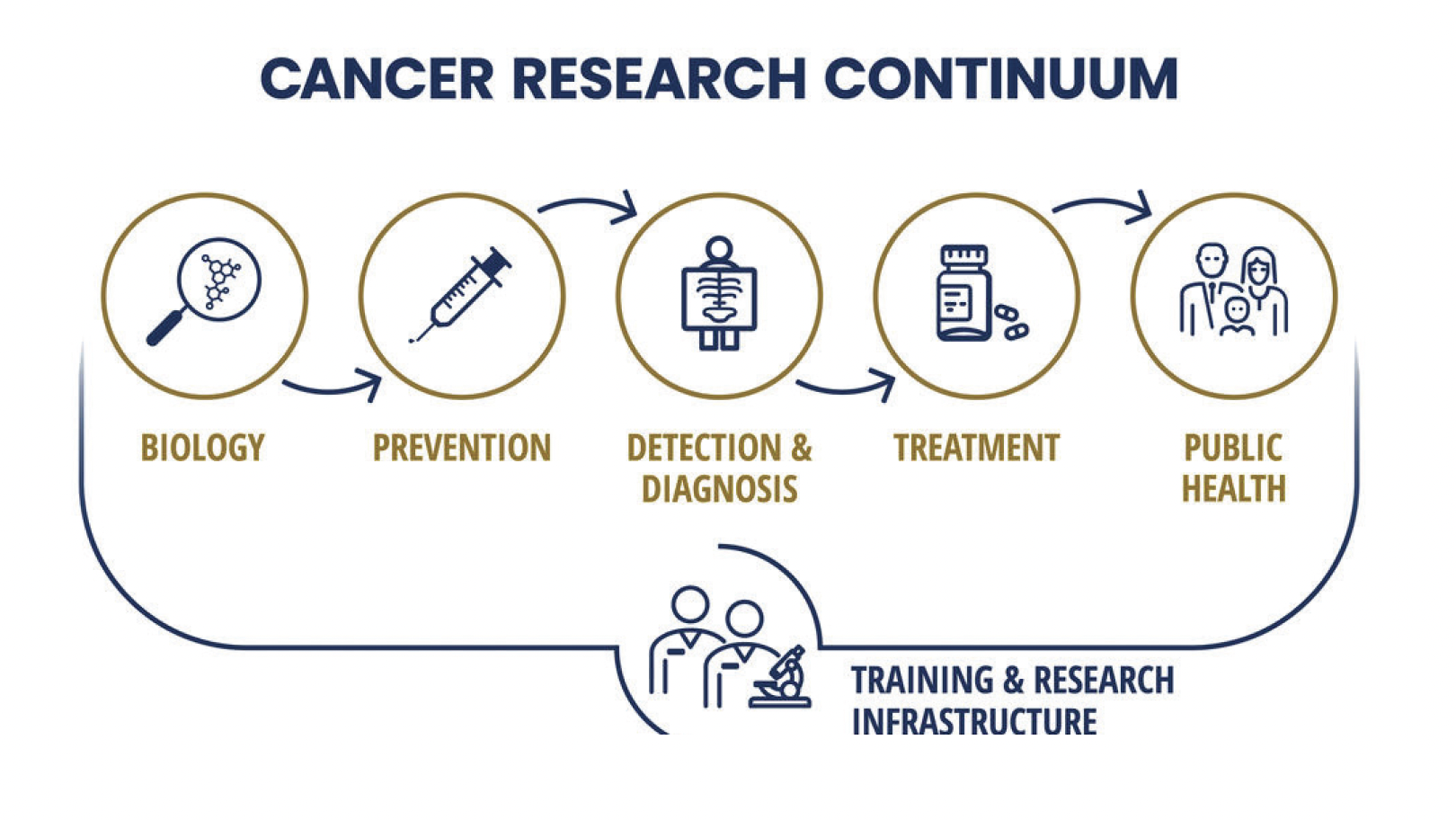
The National Cancer Institute (NCI) enables advances against cancer by investing in a broad portfolio of research, supporting the cancer research workforce, and sustaining the infrastructure that enables cutting-edge research to succeed. All these components are essential to lead progress against cancer and accomplish the goals of the National Cancer Plan.1
NCI’s support of basic, translational, and clinical research is helping patients by driving discovery to improve cancer risk assessment, prevention, detection, diagnosis, treatment, and survivorship. Sustained and robust support for NCI’s work is needed to realize the long-term vision of ending cancer as we know it.
Providing Hope: The Power of Cancer Biology Research
Virtually every new cancer diagnostic, therapeutic, or preventive measure begins with a basic science research question. Through decades of carefully planned experiments in laboratories around the world, researchers generate knowledge about cancer. It’s these investments in cancer biology research that support the groundwork needed to discover and advance lifesaving cancer interventions. Continued support is required to build on these findings.
Cancer survivors and those at risk of developing the disease rely on the innovative approaches that cancer biology research delivers.
NCI is the largest funder of the basic research that is critical for making sustained progress against cancer. Cancer survivors and those at risk of developing the disease rely on the innovative approaches that cancer biology research delivers.
For example, through cancer biology research, NCI-supported researchers have:
- Identified rare antitumor immune cells that may one day help advance personalized cancer immunotherapies for patients whose cancers do not respond to standard treatments2
- Revealed unique genetic patterns in tumors from people with lung cancer who never smoked3
- Uncovered vulnerabilities in potentially lethal brain tumors that are notoriously difficult to treat4
- Discovered early molecular changes and immune suppression in precancerous lesions that could help identify people at risk of developing lung cancer5
Discoveries such as these open the door to new treatment options where few or none currently exist and provide hope that one day all cancers will be treatable.
The knowledge gained from cancer prevention research can be used to refine guidelines and implement targeted measures to reduce the incidence of cancer.
Reducing the Burden: The Potential of Cancer Prevention
While overall cancer mortality continues to decrease,6 researchers estimate that more than half of cancer deaths are preventable. More research investments are needed to learn how to implement, improve, and build on current prevention strategies and intercept cancer more effectively by improving treatment of precancerous lesions.
Researchers have identified several preventable factors in cancer development, such as certain health behaviors, exposure to cancer-causing agents, and social determinants of health. However, there is still much more to learn about how changes in these risk factors influence cancer risk. The knowledge gained from cancer prevention research can be used to refine guidelines and implement targeted measures to reduce the incidence of cancer.
For example, NCI-funded researchers are developing experimental vaccines and other medicines to prevent cancers caused by underlying diseases. This research has enabled progress in several areas. NCI-supported studies have:
- Tested vaccines to prevent or delay the onset of hereditary cancers, such as those seen with Lynch syndrome, a condition marked by an 80% chance of developing colon cancer and a significant chance of developing endometrial cancer7
- Found that one dose of human papillomavirus (HPV) vaccine is effective in protecting young girls and boys against infections that can cause cervical, anal, and head and neck cancers—reducing the vaccine doses needed and allowing more people to be vaccinated worldwide8
- Discovered a druggable protein target to prevent nonalcoholic steatohepatitis, the biggest contributor to the recent rise in liver cancer cases9
Through rigorous scientific studies, researchers can assess the impact of cancer prevention strategies, identify areas for improvement, and develop more efficient and accessible intervention approaches to reduce the burden of cancer.
Intervening Early: The Urgency of Cancer Detection and Diagnosis Research
Accurately identifying cancer—and precancerous lesions—and assessing its severity is the primary goal of cancer detection and diagnosis research. Early detection can save lives. An imprecise approach, however, can lead to overdiagnosis, overtreatment, and unnecessary physical, psychological, and financial harm.
Investing in cancer detection and diagnosis research can help develop more sensitive, accurate, and cost-effective methods that support targeted cancer therapies and precision medicine. It will also help establish the impact that screening could have on survival rates for more cancer types and clarify any negative outcomes from multi-cancer screening tests currently under investigation.
With recent advances in NCI-funded detection and diagnosis technology, scientists have capitalized on novel opportunities. For example, NCI-supported researchers have:
- Developed a blood test that in most people can accurately detect liver cancer, the third leading cause of cancer death worldwide, even in early stages of the disease10
- Developed new artificial intelligence tools to help radiologists improve prostate cancer diagnoses for tumors that are difficult to find during biopsy11
- Combined a specialized form of microscopy imaging with a type of artificial intelligence known as deep learning to expedite brain tumor diagnosis during surgery12
Cancer detection and diagnosis research is primed with these emerging technologies. Carefully assessing their impact on cancer outcomes will limit risk and ensure benefit from these new screening and detection methods.
Innovating Treatment: The Need for More Effective and Less Toxic Cancer Therapies
For more than 50 years, NCI has played a vital role in the development of more effective and less toxic therapeutic options for patients with cancer. Despite the steady progress in improving treatments, some forms of cancer still lack effective therapies, many cancers eventually develop resistance to treatment, and not all people have equal access to cutting-edge treatments. Adding to these challenges, patients with cancer often experience severe side effects from the disease and its treatment, which for childhood cancer survivors can impact their quality of life for decades.
Investments in treatment research today will inspire and sustain the safe and effective cures of tomorrow.
These challenges can be overcome. Investments in treatment research today will inspire and sustain the safe and effective cures of tomorrow. For example, NCI-supported researchers have:
- Developed the first approved drug to treat chronic graft-versus-host disease, a complication of bone marrow transplants in which the donated immune cells attack the recipient’s body, leading to painful and debilitating symptoms13
- Designed a novel type of drug to treat glioblastoma, a highly lethal brain cancer that often develops resistance to current therapies, without harming normal brain cells14
- Conducted clinical research that led to the approval of the first new treatment in over 20 years for Kaposi sarcoma, a form of cancer that mostly affects those who are immunocompromised15
- Completed the OlympiA clinical trial, which led to the approval of a new drug that improves overall survival in people with high-risk BRCA-mutant breast cancer16
More research is needed to ensure that all patients with cancer have safe and effective therapies and the highest possible quality of life.
Improving Public Health: The Role of Cancer Control and Health Care Delivery Research
Each year, cancer has a significant impact on public health, affecting the nation’s economy and the quality of life for millions of people in the United States. NCI invests in studies to identify population-wide trends in cancer and to improve the delivery of cancer interventions.
More research is needed to design interventions that improve cancer prevention, screening, treatment, and survivorship outcomes and to address why certain racial, ethnic, and rural populations suffer disproportionately from some cancers. This research can inform policies that reduce cancer-causing exposures, ensure greater compliance with health recommendations, minimize misinformation, and address gaps in the health care system when cancer survivors transition from oncology care to primary care.
An extensive research infrastructure and a stable, diverse workforce are the backbone of the entire cancer research enterprise….
Additional investments in cancer control and implementation research will improve the lives of cancer survivors and the general population, while ensuring that all population groups benefit equally from advances in cancer research. For example, NCI-supported researchers have:
- Revealed that physical activity before and during treatment for breast cancer reduces “chemo brain,” a treatment-related cognitive impairment that affects up to 75% of people with breast cancer who receive chemotherapy17
- Developed an effective intervention to increase breast, cervical, and colorectal cancer screenings in women who live in rural locations18
- Completed simulation studies showing that a joint lung cancer screening and smoking cessation intervention would drastically reduce deaths from lung cancer19
Researchers are working hard to understand population-level impacts on cancer control and to design and test interventions along the cancer continuum that can address disparities and ensure good health for all people.
Strengthening the Research Enterprise: The Need for a Robust Cancer Research Workforce and Infrastructure
An extensive research infrastructure and a stable, diverse workforce are the backbone of the entire cancer research enterprise, and NCI provides a level and scope of infrastructure and training that cannot be matched by other organizations. Investing in these critical needs is of the greatest importance in leading progress against cancer.
All cancer research requires a robust workforce and infrastructure. This includes cancer centers where clinical trials can test new approaches to prevent and treat cancer, facilities that develop and manufacture novel technologies and medicines, electronic databases to support large amounts of biomedical data, and programs and initiatives to train a diverse workforce that drives cancer research forward. These elements need continued investments to remain strong and to capitalize on new opportunities. For example, NCI investments have:
- Funded and continue to support the NCI Cancer Research Data Commons, a cloud-based infrastructure that provides secure access to a large, comprehensive, and expanding collection of cancer research data20
- Delivered research reagents to more than 150 laboratories worldwide as part of the NCI-funded RAS Initiative21
- Launched the Cancer Moonshot Scholars22 and Early Investigator Advancement Program23 to grow and diversify the cancer research workforce
- Supported more than 1400 extramural training awards in the most recent fiscal year, 41% to predoctoral researchers and 59% to postdoctoral researchers and those in early stages of research independence
Investing in the NCI-supported cancer research workforce and infrastructure ensures that all research areas supported by the NCI budget produce the highest quality research in the most effective way possible.
References
- National Cancer Plan: Everyone Has a Role. Accessed May 29, 2024. https://nationalcancerplan.cancer.gov/
- Lowery FJ, Krishna S, Yosef R, et al. Molecular signatures of antitumor neoantigen-reactive T cells from metastatic human cancers. Science. 2022;375(6583):877-884.
- Zhang T, Joubert P, Ansari-Pour N, et al. Genomic and evolutionary classification of lung cancer in never smokers. Nature Genetics. 2021;53(9):1348-1359.
- National Cancer Institute. Vulnerability in Brain Tumors May Open Door to New Treatments. Accessed May 29, 2024. https://www.cancer.gov/news-events/cancer-currents-blog/2022/glioma-treatment-targeting-pyrimidine-synthesis
- National Cancer Institute, Division of Cancer Prevention. Identifying new biomarkers to detect lung cancer earlier. Accessed May 29, 2024. https://prevention.cancer.gov/news-and-events/blog/identifying-new-biomarkers-detect-lung-cancer-earlier
- National Cancer Institute. Annual Report to the Nation: Cancer deaths continue downward trend; modest improvements in survival for pancreatic cancer. Accessed May 29, 2024. https://www.cancer.gov/news-events/press-releases/2022/annual-report-to-the-nation-2022
- National Cancer Institute, Division of Cancer Prevention. Trials test vaccines for prevention or delay of cancers associated with Lynch syndrome. Accessed May 29, 2024. https://prevention.cancer.gov/news-and-events/blog/trials-test-vaccines-prevention-or-delay-cancers-associated-lynch-syndrome
- Zeng Y, Moscicki AB, Woo H, et al. HPV16/18 Antibody responses after a single dose of nonavalent HPV vaccine. Pediatrics. 2023;152(1):e2022060301.
- National Cancer Institute. Study identifies potential drug target to prevent some liver cancers. Accessed May 29, 2024. https://www.cancer.gov/news-events/cancer-currents-blog/2022/spectrin-fatty-liver-disease-liver-cancer
- Foda ZH, Annapragada AV, Boyapati K, et al. Detecting liver cancer using cell-free DNA fragmentomes. Cancer Discov. 2023;13(3):616-631.
- National Cancer Institute, Center for Cancer Research. Smarter Prostate Cancer Diagnosis. Accessed May 29, 2024. https://ccr.cancer.gov/news/milestones-2020/article-smarter-prostate-cancer-diagnosis
- Hollon TC, Pandian B, Adapa AR, et al. Near real-time intraoperative brain tumor diagnosis using stimulated Raman histology and deep neural networks. Nat Med. 2020;26(1):52-58.
- National Cancer Institute. FDA approves belumosudil to treat chronic graft-versus-host disease. Accessed May 29, 2024. https://www.cancer.gov/news-events/cancer-currents-blog/2021/fda-belumosudil-rezurock-chronic-gvhd
- National Institutes of Health, NIH Research Matters. Customized drug to kill brain cancer cells. Accessed May 29, 2024. https://www.nih.gov/news-events/nih-research-matters/customized-drug-kill-brain-cancer-cells
- National Cancer Institute, Center for Cancer Research. FDA approves pomalidomide for AIDS-related Kaposi sarcoma. Accessed May 29, 2024. https://ccr.cancer.gov/news/article/fda-approves-pomalidomide-for-aids-related-kaposi-sarcoma
- Tutt ANJ, Garber JE, Kaufman B, et al. Adjuvant olaparib for patients with BRCA1- or BRCA2-mutated breast cancer. N Engl J Med. 2021;384(25):2394-2405.
- Salerno EA, Culakova E, Kleckner AS, et al. Physical activity patterns and relationships with cognitive function in patients with breast cancer before, during, and after chemotherapy in a prospective, nationwide study. J Clin Oncol. 2021;39(29):3283-3292.
- Champion VL, Paskett ED, Stump TE, et al. Comparative effectiveness of 2 interventions to increase breast, cervical, and colorectal cancer screening among women in the rural US: a randomized clinical trial. JAMA Netw Open. 2023;6(4):e2311004.
- Meza R, Cao P, Jeon J, et al. Impact of joint lung cancer screening and cessation interventions under the new recommendations of the U.S. Preventive Services Task Force. J Thorac Oncol. 2022;17(1):160-166.
- National Cancer Institute, Center for Biomedical Informatics & Information Technology. NCI Cancer Research Data Commons. Accessed May 29, 2024. https://datascience.cancer.gov/data-commons
- National Cancer Institute. The RAS Initiative. Accessed May 29, 2024. https://www.cancer.gov/research/key-initiatives/ras
- National Cancer Institute. Cancer Moonshot Scholars. Accessed May 29, 2024. https://www.cancer.gov/about-nci/organization/crchd/diversity-training/cancer-moonshot-scholars-diversity-program
- National Cancer Institute. Early Investigator Advancement Program (EIAP). Acccessed May 29, 2024. https://www.cancer.gov/about-nci/organization/crchd/diversity-training/eiap